Fonctions: Polynômes de degré supérieur à 2
 Inéquations de degré supérieur à 2
De la même manière que nous avons résolu des inéquations du second degré, nous pouvons résoudre des inéquations de degré supérieur à 2.
Résolution d'inéquations de degré supérieur à 2
| Procédure | Exemple | |
| Nous résolvons l'inéquation suivante \[\blue{f(x)} \gt \green{g(x)}\] où #\blue{f(x)}# et #\green{g(x)}# sont des polynômes. | #\blue{x^6+x^3+6} \gt \green{-2x^3+10}#  Les solutions sont: #x \lt \sqrt[3]{-4} \land x \gt 1#. |
|
| Étape 1 | Nous résolvons l'équation \[\blue{f(x)} = \green{g(x)}\] | |
| Étape 2 | Nous traçons les graphes de #\blue{f(x)}# et de #\green{g(x)}#. | |
| Étape 3 | À l'aide de l'étape 1 et 2, nous déterminons les valeurs de #x# pour lesquelles l'inéquation est vraie. |
Notez que cette procédure est également valable pour les inégalités larges #\geq# et #\leq#. Alors les valeurs #x# des points d'intersection font également partie de la solution.
#d\gt -4^{{{1}\over{5}}}\land d\lt -2^{{{1}\over{5}}}#
| Étape 1 | Nous résolvons l'équation #d^{10}+6\cdot d^5-6\cdot d+59=51-6\cdot d#. \[\begin{array}{rcl} d^{10}+6\cdot d^5-6\cdot d+59&=&51-6\cdot d \\ &&\phantom{xxx}\blue{\text{équation à résoudre}}\\ d^{10}+6\cdot d^5+8&=&0 \\&&\phantom{xxx}\blue{\text{réduction à }0}\\ \left(d^5+2\right)\cdot \left(d^5+4\right)&=&0 \\&&\phantom{xxx}\blue{\text{factorisation}}\\ d^5+2=0 &\lor& d^5+4=0 \\&&\phantom{xxx}\blue{A\cdot B=0 \text{ si et seulement si }A=0\lor B=0}\\ d=-4^{{{1}\over{5}}} &\lor& d=-2^{{{1}\over{5}}} \\&&\phantom{xxx}\blue{\text{résolution des équations}}\\ \end{array} \] |
| Étape 2 | Nous traçons les graphes de #y=d^{10}+6\cdot d^5-6\cdot d+59# (bleu) et de #y=51-6\cdot d# (vert). 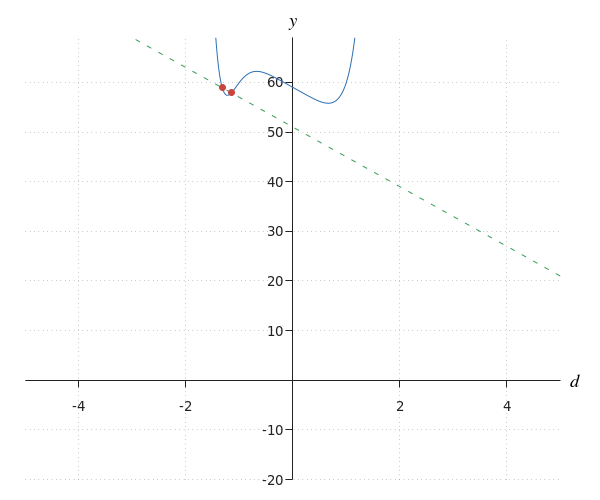 |
| Étape 3 | Nous déterminons les solutions de l'inéquation à partir du graphique. \[d\gt -4^{{{1}\over{5}}}\land d\lt -2^{{{1}\over{5}}}\] |
Déverrouiller l'accès complet

L'accès des enseignants
Demander un compte de démonstration. Nous allons vous aider à démarrer avec notre environnement d'apprentissage numérique.